| The legend | Web links | Tarn related papers |
Last Updated: 21 January 2014
Urswick Tarn
First some parameters
Urswick Tarn is a rare marl tarn located at 54º 09' 38" North, 3º 07' 08" West on the Furness peninsula in the United Kingdom. It covers an area of approximately 5.63 hectares and has a maximum depth of approximately 12 metres. The tarn sits at an elevation of approximately 34 metres above sea level. From the southern end of the tarn its water is drained by Gleaston Beck which flows 7 km to Morecambe Bay and from there the water enters the Irish Sea.
The geology of the district is fundamental to this tarn
The district around Urswick Tarn is over limestone rocks dating from the Carboniferous Period around 337 million years before present. The majority of the water entering the tarn rises from springs located at its bottom and is therefore groundwater which has travelled from around the catchment area through underground passages dissolved within the limestone. The extent of that catchment is not currently known. The dissolution of the limestone means that the water entering the tarn has a high content of calcium carbonate and is what would generally be referred to as 'hard water'.
The tarn is very rare
Because limestone dissolves in this way creating fissures, caverns and cave systems, some means must be present for retaining the water in the tarn and preventing it from soaking away as rain normally does over limestone country. In the case of Urswick Tarn, the means by which retention is achieved is not yet fully understood, but it may possibly be attributable to a particular feature in the strata of limestone immediately below the tarn. This limestone is known formally as the Urswick Limestone Formation and has within it a particularly thick band of shale known as the Woodbine Shale. In some instances shale bands are impermeable. The fact that water is retained at all, is one reason for Urswick Tarn's rarity.
What is a marl bench?
When a body of water contains a high level of dissolved calcium carbonate, precipitation of that compound takes place during the summer months onto plants which are growing in the water. As the summer progresses, plants acquire a very noticeable encrustation of calcium carbonate and this settles to the bottom when the plants eventually die-back at the end of the summer. This results in a gradual build-up around the perimeter of the tarn and over many years accumulates to form a bench which slowly progresses inwards, thus reducing the area of the water body. Calcium carbonate accumulated in this way is known as marl and the bench is known as a marl bench. Bodies of water with marl benches are also rare and in the case of Urswick Tarn it has a marl bench that is well developed.
Caution! Do not enter
One of the consequences of the peripheral margin of a tarn developing in this way, is that the transition between shallow water and deep water occurs quite suddenly. This makes it particularly dangerous for anyone entering the water and venturing away from the edge. In the case of Urswick Tarn, around which the village of Great Urswick is situated, it used to be the regular warning given to the children of the village by their parents, who much more likely in those times than now had themselves grown up in the same locality, that they must not enter the water. In former times the sudden depth increase was well known and feared, even though the cause of its presence was not then understood.
Beautiful but vulnerable
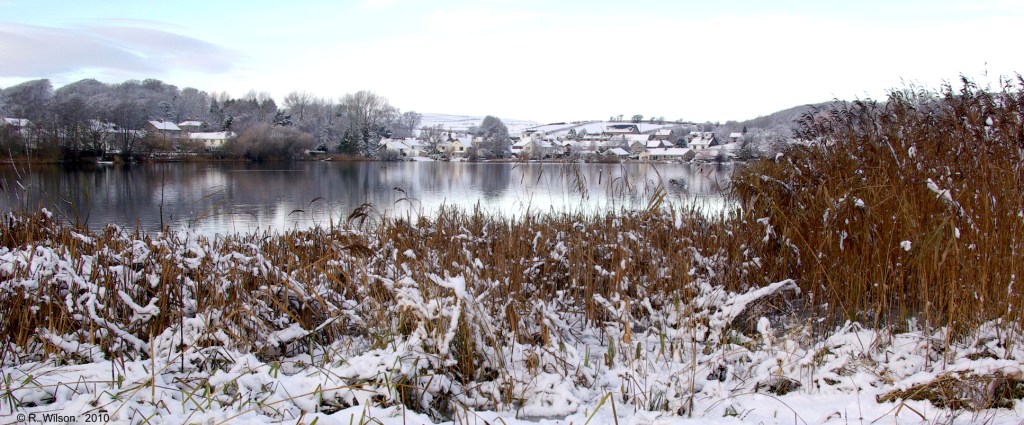
The outcome of these developmental processes, as well as the erosive forces of glacial action around 14,000 years ago which ceased prior to the deposition of the present marl bench, and not to mention the possibility of cavern collapses in the limestone beneath the tarn at some time in its formative or later history, is a truly beautiful tarn of considerable rarity. The setting for the tarn is at the head of a valley surrounded on three sides by rising ground on which are the remnants of ancient field patterns which speak of the considerable age of the settlement below.
Nature has been kind in providing the geomorphological outcomes which are, rightly, so highly regarded in modern times. But it is to be regretted that much of that regard is narrowly focussed on perceived visual amenity. Those outcomes are extremely vulnerable to insensitive hand-of-man projects which can so easily and irretrievably destroy that which has been so long in the making.
Urswick Tarn may well be unique
Having discussed the body of water and its margins, events in history have made the bottom of this tarn quite exceptional and demanding of specific comment. At the bottom of the tarn is what is now an unseen legacy of nineteenth century haematite mining that took place on Lindal Moor, 2.3 km to the north west. This ore field was part of a world scale deposit which was mined at a number of locations on the Furness peninsula. As the mines on Lindal Moor got deeper, they encountered an increasingly severe problem from flooding which was partially solved by the installation of extremely large pumps, the discharge from which was piped to an underground drain that was excavated to carry the water and accompanying haematite effluent to Urswick Tarn. The very considerable sedimentary burden from that source now rests at the bottom of the tarn and has been found to be over 2 metres thick at one location where a core was taken which penetrated to the natural organic sediments below. Since this discharging from the mines ceased sometime around 1900 the alien sediment slowly migrated over the decades away from the inflowing groundwater springs which for many years had regularly disturbed and lifted the introduced sediment following any significant rainfall. During these periods of disturbance the tarn took on a very distinctive red colour until, over a period of days, the sediment again settled to the bottom.
The above paragraphs have provided a brief explanation as to why this marl tarn is so rare, but the incongruous presence of the haematite sediment, sitting as it does on top of the marl and organic sediments which date back to the end of the last ice age, is very likely to have made Urswick Tarn unique. Future research may reveal the full consequences of that half century period when Urswick Tarn provided a convenient sump for the mine owners of the time. Buried in the sediments is the story of how an original ecology was destroyed and how a new one has recovered, albeit in an environment much changed from the original, and possibly with some distinct differences that are attributable to that imposed environment.
Duty of care:
The right of future generations to inherit this rare, complex and beautiful tarn, together with its rare marginal fen that has evolved over the marl bench below, in a condition that is, at least, no more adversely impacted by man than is the case at present, is surely beyond question. Recognition of the consequential duty of care, and of our collective responsibility to those who will follow us to care for the tarn, is an imperative that we must not fail.
Footnote:
The photograph at the head of the page is taken at the southern end of the tarn looking north with an area of floating bog in the foreground.